Establishment won’t destabilise a Corbyn government says author of “A Very British Coup”

chris mullin

Chris Mullin, author Pic credit: Twitter

CROSS POSTED ON BYLINE.COM

Chris Mullin, the former Labour minister and MP, last night told an audience of MPs and peers that he did not believe that the Establishment would seek to undermine a future Labour government  led by ” saintly” Jeremy Corbyn .

His  riposte came a month after Sir Richard Dearlove, the former head of MI6, expressed worries that Corbyn had not ditched his left wing views, had met people who were not friends of Britain and said he was worried about him becoming PM. The charge has been made also by Sajid Javid, the home secretary who describes Jeremy Corbyn as ” a threat to our national security.”

Chris Mullin was giving a talk as part of John Bercow’s Speaker’s Lectures series  after the publication of his autobiography Hinterland, which describes his life as a war  journalist. Mp and minister and a chair of the influential home affairs committee.

He is most famous for his novel written in 1982 ” A Very British Coup” which became a BBC TV series describing how a left wing Labour MP with strong views on disarmament and an ally of the trade unions wins a general election with a landslide victory only to be undermined by the security services, the Establishment and the Murdoch Empire.

Although written some 33 years before the sudden rise of Jeremy Corbyn the novel is now seen as prescient of events that did change the direction of the Labour Party. At the time it was written Tony Benn not Jeremy Corbyn was seen as the great danger.

But despite the novel’s gloomy prognosis Mr Mullin does not see this happening should Jeremy Corbyn win the next election.

” I think MI5 has been cleaned up  in the last 30 years “, he said. He was not so certain about MI6 after the comments of Sir Richard Dearlove.

Mr Mullin himself was branded as part of the ” loony left ” by the right wing media particularly as he championed the cause of the  six Birmingham bombers who  were found guilty of blowing up two pubs killing 21 people and injuring 182 others but had their convictions quashed 16 years later. This was one of the greatest miscarriages of justice.

He disclosed that although he was on the left of the party he had not voted for him as party leader as he did not agree with all his policies. He described Jeremy as a ” saintly person” who  has always stood by his beliefs.

He also had a surprise for his audience. He is a writing a sequel  to A very British Coup which covers the current Brexit crisis. It is to be published on March 29 next year – the day Britain is due to leave the European Union.


Can the Independent Child Sex Abuse Inquiry really properly investigate Elm Guest House?

Elm-Guest-House

The former Elm Guest House in Barnes, south west London, now a respectable residential property

CROSS POSTED ON BYLINE.COM

The news that the Independent Inquiry into Child Sexual Abuse is to investigate events  surrounding Elm Guest House in the London borough of Richmond is to be welcomed. But I have serious doubts whether the inquiry will have the time and space to properly investigate.

The item is one of a number sandwiched into three weeks of hearings under the Westminster  strand of the inquiry and Alexis Jay, the chair made it clear ,last month there is no intention to make any of the investigations exhaustive.

As she said:”It is important that everyone, including the public, understands that this is not, and has never intended to be, an exhaustive examination of  all Westminster-related child sexual abuse issues. Even focusing on institutional issues, a comprehensive
examination of all the allegations that have been made, and all the questions that have been raised, particular on the internet, would involve hearings lasting months, if not years.”

So what will this brief cover. Again  according to her statement it will be limited:

“Another category of these investigations concerns allegations relating to Elm Guest House. Those allegations include possible misconduct on the part of the Metropolitan Police in the way in which investigations into goings on at Elm Guest House were conducted, and also allegations that the fruits of those investigations were covered up.

“The latter allegations include the well-known allegation that evidence relating to Leon Brittan’s presence at and/or involvement with  Elm Guest House was suppressed. We propose to call some more detailed evidence relating to these cases at the hearings next year.”

So even the remit looking at Elm Guest House will be confined.

I got involved in reporting this after a source  who was neither a  child sex abuse survivor nor a politician, stumbled across it during an unrelated dispute. The source had also discovered – and I have never had time  to investigate this – allegations of elder abuse at a home in Richmond. Until then as a journalist I had never investigated any cases of alleged child sexual abuse.

What followed was a whirlwind of allegations, some involving national politicians, others pointing to a lack of duty of  care for children by Richmond Council at Grafton Close children’s home, a muddled police investigation, and a series of  very disturbing stories from people  who were children at the home at the time.

Father Anthony McSweeney

Father Anthony McSweeney; Pic Credit: BBC

It ended with the successful prosecution of  a well connected Roman Catholic priest, Father Tony McSweeney and charges against the former deputy manager of the children’s home., John Stingemore.  McSweeney was sentenced to three years in gaol, Stingemore died a fortnight before he was due to appear before Southwark Crown Court.

Unlike Operation Midland the Met Police  investigation did produce results. In McSweeney’s case it forced the Roman Catholic Church to commission a report into what went wrong when it was revealed that the paedophile priest was caught some 30 years later with a file of indecent pictures on his computer while playing a major pastoral role with young boys and men in Norwich scouts, boxing clubs and with the Norwich City Football youth team.

While the evidence about any connection between Elm Guest House and Grafton Close was never tested in court because of Stingemore’s death the trial did reveal that both McSweeney accompanied  by Stingemore took boys away from the home without permission for weekends at a flat in Bexhill. They were present where various alleged sexual assaults took place. If Stingemore had been convicted, the jury would have found out that soon after leaving Richmond, and working for another authority he was arrested and convicted of child sexual abuse.

All this suggested that Richmond Council was seriously amiss in looking after children in its care and that both elected councillors and officials should have known what was  going on. But it looks that the inquiry would not look at this aspect, allowing the council to be let off the hook.

As serious as this is when Elm Guest House was raided by the police, Grafton Close was designated as a place of safety for any children that might be found there. Effectively the police  unwittingly were sending children to an establishment run by a paedophile with a paedophile friend who regularly visited it.And by alerting Grafton Close in advance if there was a connection with Elm Guest House, the establishment would have got a tip off about the raid.

As for the place itself  it seems like many hotels that welcomed gay guests in late 1970s and early 1980s, tolerated both consenting gay adults staying overnight and possibly paedophiles. The fact is unlike today homosexuality was viewed as a closet activity, driving both adults and paedophiles to the same venues. The situation is reflected in hotels used as gay haunts in North Wales at the same time.

As for VIPs and a police cover up  at Elm Guest House the inquiry will have its work cut out. Perhaps they can throw light on the Metropolitan Police’s reply to Channel Four Dispatches that Sir Cyril Smith visited the venue. As for Leon Brittan, the identification that he is alleged to have visited the venue come not from survivors or any list compiled by anybody but from enraged residents of this posh Barnes road. They say they spotted  both him  and at other times boys getting out of cars late at night and were fed up with this sort of traffic in a respectable neighbourhood.


MPs slam complacent equality watchdog and the government over “rife ” ageist discrimination

ImageVaultHandler.aspx

The Equality Act: Government complacency is allowing rife discrimination in the workplace against the over 50s Pic credit: Parliament UK

CROSS POSTED ON BYLINE.COM

A damning report from the  Commons women and equalities committee has attacked the country’s equality watchdog and ministers for their complacent attitude in tackling age discrimination in the workplace and elsewhere.

The report released by the all party committee of MPs warns that the talents of up to one million women over the age of 50 are being wasted by outdated employment policies. Its strongly worded condemnation of the Equality and Human Rights Commission and ministers responsible for equality follows what can only be described as a pretty lack lustre response from both.

Chair of the Women and Equalities Committee, Maria Miller MP, said:

“Without effective intervention from the Government and EHRC, we cannot see how discriminatory practices against older people in employment, that we know are rife, will be tackled. That’s why I find the responses we have received today disappointing as we had hoped they would have worked together to agree specific enforcement actions across both the public and private sectors.

Our Committee will be taking follow up action to make sure we get the change that is desperately needed.”

The response from MPs highlights what they see as a failure to implement the  2010 Equality Act. They are particularly scathing of the failure by the EHRC which has powers – which appear to be rarely used – to use enforcement procedures  against employers who have ageist recruitment policies.

The lack of the use of its powers is worrying given that campaigners for 50s women who are waiting up to six years to get a pension also want the EHRC to use its powers to remedy what they see as discrimination against this group. This group who are being forced to look for work until they are 65 – are facing a double bind of  finding employers don’t want them while the state won’t give them a pension.

They have even had the facetious suggestion from Guy Opperman, the pensions minister, that they take jobs as apprenticeships at £3.60 an hour while they wait until they get a  pension.

The EHRC today said it would take action – even though this seems to be confined to fine words rather than deeds.

A spokeswoman  said: ““Everyone has the right to work and the right to a working environment that allows them to achieve their full potential. We have taken and will continue to take robust enforcement action, using all of our statutory powers, to tackle unlawful discrimination and ensure that no one is excluded from the workplace. This includes enabling Britain’s employers to benefit from the talent and contributions of workers of all ages.

“The right to request flexible working should apply from day one in all jobs and we have stressed the need for employers to make their workplaces accessible for everyone, including older people, parents and carers. We have also sought to tackle bias in recruitment by taking action against discriminatory adverts that request characteristics or terms that are associated with a particular age group.”
MPs are particularly angry that the government will not enact section 14 of the Equality Act – which would allow people to bring multiple ground cases against employers who discriminate against them. Thus an older woman could not bring a case on both age and sex – she has to choose one or the other.

Both former women’s minister Harriet Harman and the Fawcett Society have condemned ministers for not doing this. The government says it won’t do it because it increases burdens on business and promises more research in its response. One has to ask as this legislation was passed by Parliament – there must have been some research already behind it – so this is a pretty lame excuse.

The government uses the same excuse of putting too much a burden on employers to make it mandatory for firms employing over 250 people to publish an age breakdown of staff. Yet Whitehall already does it.

Altogether this is a pretty pathetic response from both the government and the watchdog to a serious issue. But I am very glad that the committee is also very dissatisfied and intends to pursue both organisations to come up with something better. You can get the full report here.

Exclusive: Case for Judicial Review for BackTo60 challenge to government on pensions set for November 30

royal-courts-justice-passes-misuse-602677

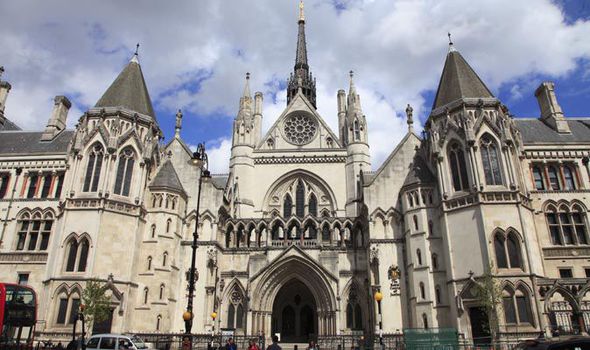
Royal Courts of Justice – venue for handing in the papers for a judicial review for the 50s women

CROSS POSTED ON BYLINE.COM

The High Court is to hear the case for a judicial review into the government’s mishandling of the raising of the pension age for 50s women on November 30.

The court granted a two hour hearing today.This means that Michael Mansfield and his team will argue the merits of the case for a judicial review.

The Department for Work and Pensions will oppose any judicial review.  The judge  will decide whether it can go ahead.

The granting of a two hour hearing  is significant in the sense that the court has decided that the merits of both sides of the argument  must be examined thoroughly. Previously the court had thought that 30 minutes was enough to hear the arguments – suggesting that it could be turned down without much debate.

The announcement is a victory for the lawyers arguing the  case and for BackTo 60 in taking such an uncompromising stance. The government has so far refused to budge an inch in recognising the grievances of the 3.8 million women who have lost out – some of them living in dire poverty as a result.

The case will be backed up by the paper from Jackie Jones, a law professor at the University of the West England She has produced the report,  which shows that this group of women have suffered discrimination contrary to an international  convention signed by successive UK governments. It is not a legal document but it is an expert opinion.


Danger on the Line: Damning safety findings that put passengers and train drivers at risk

stream_img

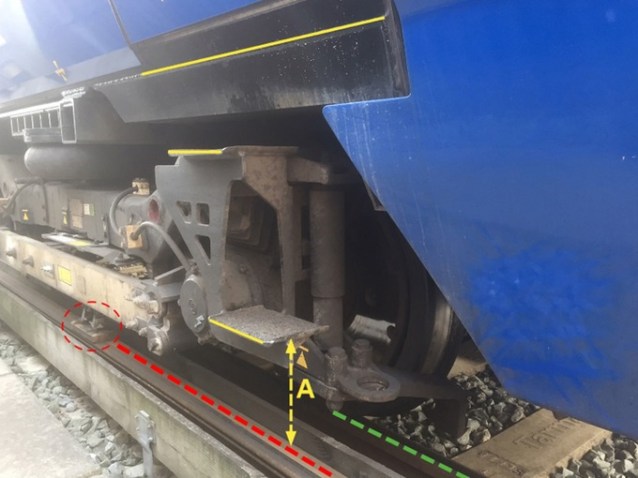
People had to step over this live rail to get off the train. It didn’t even have a protected board at the time Pic credit: Aviva Trains

CROSS POSTED ON BYLINE.COM

A  damning report was published this month by the Rail Accident Investigation Branch into an incident nearly a year ago which led to 450 passengers being urged to leave a stranded train and walk along the tracks within inches of a live high voltage electric rail.

The report is not only critical of this incident but raises the question whether there are systemic failures in our semi privatised railways which need urgently addressing. It reveals a string of other incidents that have happened in the last five years.including two cases where express train drivers had to lie under their trains to avoid being mowed down by trains coming in the opposite direction.

These include;

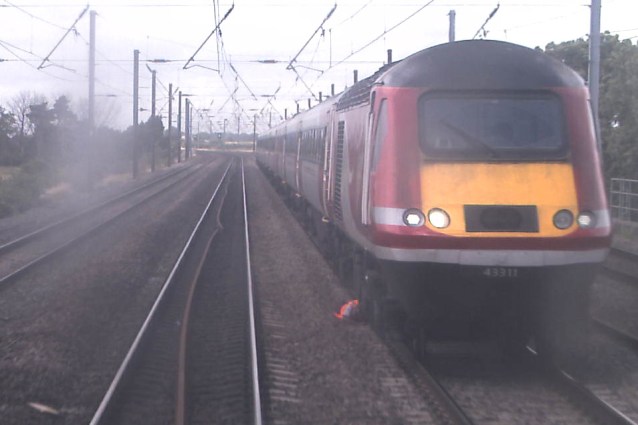
A Virgin Express train driver had to cower under his Inverness to London express just north of York to prevent being mowed down by a 105mph express in the opposite direction. The trainee signalman had failed to tell the driver of the stopped train that he had not halted other trains in the area.

Exactly the same thing happened again at Stafford six months ago when a Manchester to London Virgin express stopped because of a fault. The driver who was badly shaken had to hide under the train to avoid being run over by an express coming in the opposite direction.

Passengers getting out on to the tracks at Gospel Oak and waking to the station in 2013 – and a suburban train going forward without permission to take passengers off at Hackney Downs and almost overrunning a junction where it could have crashed into a train coming in the opposite direction.


Figure_2

You can just see the driver nearly under the Virgin Train north of York from this CCTV picture. Pic Credit: Virgin Trains

This latest report  was about a passenger train that was halted outside Peckham Rye station in South London last November after a fault automatically stopped the train.

The driver , who did not have a guard, got the go ahead from the private operator Aviva’s control centre to get passengers off the train. As the report says:

“This involved passengers climbing down vertical steps to ground
level, very close to the live electric conductor rail (third rail) and walking along the side
of the line for about 30 metres to Peckham Rye station.

“Soon afterwards, an operations manager from Govia Thameslink Rail, which manages
Peckham Rye station, contacted the member of station staff and realised where they
were and what was happening. The operations manager immediately instructed
the driver to stop the evacuation, and requested that he contact the signaller and
his company’s controller for further instructions. ”

…”The train driver and the signaller did not reach a clear understanding
about the actions that were required to safely detrain the passengers. The delay
caused unrest among the passengers on the train and contributed to stress and task
overload of the driver, which affected his decision making. The driver’s experience
and skills did not enable him to cope with these demands, and Network Rail did
not effectively implement its own procedures for managing an incident involving a
stranded train.”

The scandal revealed here is the lack of communication between Aviva’s control centre, Network Rail, the signalman, which all put passenger safety at risk.

Of course both Network Rail and Aviva have said they have taken measures to deal with it. But the report reveals that in Aviva’s case very little has been done – particularly at its control centre. Inspectors returned after the incident and found:
l the environment within the control room was noisy and poor equipment was still
being used, both of which may cause distraction, and the floor plan was still too
small;
2 poor communications (verbal / IT systems and written notes) were observed
and still evident;
3 a lack of coordination and awareness of the different roles within the control
room was still evident”

Simon French,Chief Inspector of Rail Accidents concluded: “Following previous incidents, the railway industry has put in place policies for managing incidents in which trains become stranded. This incident has shown that when things go wrong, these policies may not be effective. …. We are recommending that, both locally and nationally, the incident management arrangements should be reviewed, and processes put in place to exercise them regularly. It’s not enough to have a plan – it must work when it is needed, and if it has never been practised the chances are it won’t work.”

The report on Peckham Rye can be read in full here  and the reports on the Virgin train incidents can be read here and here.


The day the women fighting for their pensions brought Westminster to a standstill

20181010_162148.jpg

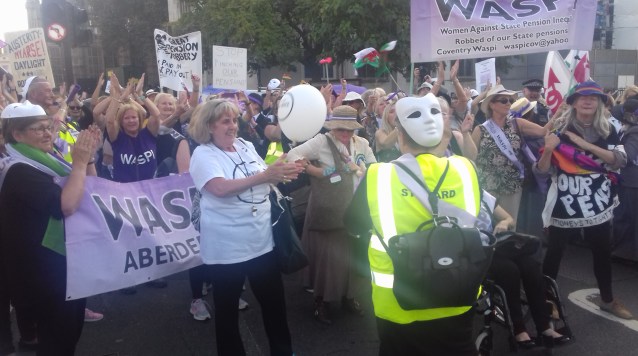
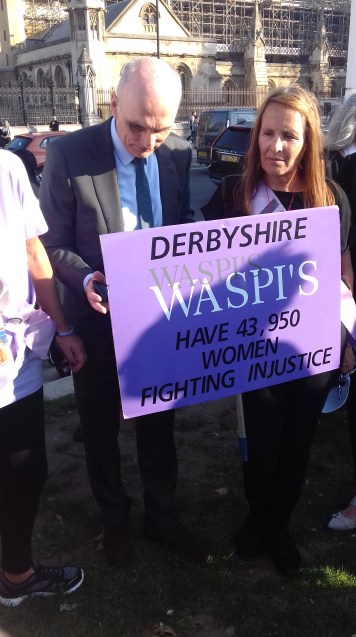
50s women reclaiming the street outside Parliament

CROSS POSTED ON BYLINE.COM

A decade ago this would have made headline news. Hundreds of  50s women deprived of their pensions until they reach 65 or 66 blocked the road in Parliament Square for over an hour yesterday. The police – just five of them – had to divert traffic away from Parliament as they sang slogans deriding Theresa May  from ” We paid In,  U Pay Out ” to ”  Hey, Hey, Theresa May, Theresa May, how many women who have you robbed today ” in an extraordinary display of anger at successive governments decisions to raise the women’s pension age from 60 to 66.

The noise  from the vibrant  demo drowned out irritated van drivers, bus drivers and motorists tooting their horns as they were stuck on the one way system round the Square. But the women were more than a match for the motorists, the police and certainly are making an impact on MPs.

The decision to block the road was not planned  and taken spontaneously by some of the protesters and led to a traffic jams right up Whitehall. Even Fiona Bruce, the BBC newscaster had to flag down a passing police car to get to Millbank to present the six o’clock news.

The protest  began with a 1000 strong rally in Hyde Park bringing together Backto60, Waspi and the ” We Paid In, U Pay Out” groups under a #One Voice and ” shoulder to Shoulder ” banner. Groups from as far away as Aberdeen, Cornwall, Wales, Tyne and Wear and Derby came to London to voice their anger.

It has got the backing of the Fawcett Society, the Women’s Equality Party and the SOS Initiatives  who have highlighted the desperate plight of the women , some of whom have contemplated suicide or self harm.

What was  clear at Westminster is that it is attracting support from senior people in the leadership of both the Labour Party and the Scottish Nationalist Party, the two biggest opposition groups in Westminster. John McDonnell’s office sent over a senior researcher and unless I was mistaken, Laura Alvarez, wife of Jeremy Corbyn, who keeps a low profile but I would bet will be telling the Labour leader about the strength of feeling there.

20181010_155332.jpg

Chris Williamson examines the Derby Waspi banner

Other Labour MPs there included Chris Williamson, the Labour MP for  Derby North;Laura Smith, shadow Cabinet Office minister and MP for Crewe and Nantwich; Battersea MP Marsha de Cordova; and a number from Scotland and the Midlands. Two prominent Scottish Nationalists, the Westminster leader Ian Blackford and Mhairi Black also pledged support. Tory MPs were noticeable by their absence.

What is clear is this issue which I fully support – I did address the rally myself on the key issues- is now going places. This weekend it made the mainstream media, the next stage must be inside the courts and Parliament itself.

20181010_153227.jpg

The protesters arrive at Westminster 


Conservatives v Corbyn: How the Tory party’s policy vacuum has left them floundering among the under 45s

1200px-Official_portrait_of_George_Freeman_crop_2

George Freeman, MP – man behind revitalising Tory policies. Pic credit: Wikipedia

CROSS POSTED ON BYLINE.COM

Beyond the  media hype of the Brexit battle between Boris and Theresa May this year’s Conservative Party conference was a heart searching  and navel gazing spectacle.

Clearly still rattled by the result of 2017 election where Theresa May lost them their overall majority – by far the biggest topic on the fringe was how can they woo back droves of people under 45 who have deserted them for Labour.

Unusually for a party in power  there were strident calls to develop new policies to win back these lost voters. Usually parties in government can take the initiative as they have the reins of power  and can produce plenty of fresh ideas.

But the Tories at this conference were behaving like a party in opposition – a huge navel gazing exercise in a desperate search for new policies. Tory MP Chris Skidmore, policy vice chairman of the party, virtually gave the game away at a reception for the Conservative Policy Forum – when he alluded to the great revival of ideas by  Sir Keith Joseph, which propelled Margaret Thatcher into Downing Street.  But that was the 1970s when the party had lost power after Edward Heath’s disastrous performance.

David Cameron also tried to soften the image of the party – again the new ideas came when the party was in opposition in 2008.

So what are they trying to do? One of the more illuminating debates came at the  Centre for Policy Studies fringe with the intriguing title, Today’s Millenials, Tomorrow’s Conservatives?

Chaired by Times columnist, Rachel Sylvester,it was platform for two potential rising stars, Sam Gyimah, the universities minister and a late replacement, Guy Opperman, the pensions minister.

The two were remarkably honest about the dilemma.  Sam Gyimah admitted they were used to 18-21 year olds being left wing radicals but not the 25 to 45 year old age group. whom would be in work and bringing up families.

He blamed the continual war within the Tory party over Brexit as putting off young voters.

Guy Opperman admitted that they would not win by negative campaigning against Corbyn ”  We won’t win  by portraying Corbyn  as an insane  antisemitic Hamas supporting, Cuba loving, terrorist” he said.

That message did not seem to have reached the Tory party platform where Sajid Javid  , the home secretary, warned of the security risk of having Corbyn as Prime minister and May devoted part of her speech to denouncing Corbyn over antisemitism, supporting Russia, decrying Nato and appearing on Press TV.

What did they want. Well, without a real trace of irony, it was the need for momentum without the capital M.

Energy, drive, policies that were inclusive, equal pay for women, responsible capitalism, support for the NHS and more and more housing. In olden times, it would be called progressive conservatism. Guy Opperman as pensions minister, was asked by one member of the audience whether to remove parts of the triple lock on pensions to assuage the plight of the young. He was remarkably silent on this saying he did not want to make manifesto commitments at this time. Pressed afterwards he said he liked to get away from always talking about pensions.

But what was missing was any big idea on how to tackle the issues that Labour was pushing – the failure of private firms running the railways, over crowded classrooms, police and prison service  in crisis,giving workers a bigger stake in private companies. They will have to offer real alternatives to wean voters away from Labour. Their only big point was that Corbyn hadn’t the money to do anything about it without ruinous taxation and borrowing.

It is all predicated on Britain entering the sunny uplands once we have left the EU and can plan for a post Brexit society. If Brexit turns into chaos it will further alienate that target age group.

Labour should not be complacent about the dilemma the Tories face. At the Conservative Policy  Forum reception there was a strong rallying cry for people to set up constituency wide policy groups to try and draw up more attractive policies and to reach out to non Conservatives – I expect aimed at that 25-45 year age group – to participate.

Just before I left I had a word with  George Freeman, Conservative MP for Mid Norfolk, one of the most active MPs seeking new Tory policies to appeal to the younger voter. Surprised to find that a hack had sneaked into the reception to hear about their plans, he jested I was only there for the drink. More seriously he asked:

” Why don’t you join  the Conservative forum and help us devise new policies?”

I politely declined, made my excuses and left.


Boycott this mean Treasury National Savings ISA account that is slashing interest rates for pensioners and the poor

treasury

HM Treasury: Slashing your savings in National Savings

CROSS POSTED ON BYLINE.COM

Over a month ago bank rate rose for only the second time in a decade – promising a bit more money for people who have savings and are seeing their money eroded by inflation.

They would probably hope to get an extra paltry 0.25 per cent interest on their already diminishing  savings – lucky to get just over one per cent on an instant access cash ISA when inflation is running at 2.7 per cent.

However the well paid top mandarins and ministers at the Treasury and National Savings ( their chief exec, ex Barclays banker Ian Ackerley is on a pittance of £185,000 a year plus an annual £69,000 payment into his pension) had other ideas. Why not use the cover of the bank rate rise to slash the interest we already pay out to people who use National Savings as a safe haven but need to access money to meet unexpected bills for a broken boiler or fridge. Everybody will think interest rates will go up, they wouldn’t think anyone would slash them now

So in July when both the Treasury and National Savings knew a bank rate rise was imminent they agreed not to put up the rate of their cash isa but CUT it by 0.25 per cent to just 0.75 per cent. It was though Mark Carney, the governor of the Bank of England was about to announce a bank rate cut not a bank rate rise.

Today the new cut came into effect – just at the point when other banks and building societies are putting their rates on equivalent cash isas UP.

You would think from the blurb on their website that National Savings would do the opposite. Their comment on interest rate changes reads:

 “Can NS&I change the interest rate?

Yes – the rate is variable so we can change it up or down from time to time, for example when the Bank of England base rate changes or when rates in the general savings market change. See the customer agreement (terms and conditions) for more details.”

So we know now  in this case when the bank interest rate goes UP,  the National Savings rate will go DOWN.

And as for other providers- Metro Bank for example, has an equivalent instant access cash isa which was paying less than National Savings at 0.75 per cent. But since the bank rate rise it is now paying more. Its new rate is 0.90 per cent -UP 0.15 per cent while National Savings are DOWN 0.25 per cent to 0.75 per cent. Which Money? has other recommended providers paying more.

So what’s their explanation?

A spokesperson said today :”The decision to reduce the interest rate on Direct ISA was taken in order to deliver positive value for taxpayers. NS&I sets its interest rates to balance the interests of its savers, taxpayers and the stability of the broader financial services sector.

“In order to take this decision, we made a proposal to HM Treasury which was approved. We review the rates on all of our products regularly and recommend changes to HM Treasury when we believe they are appropriate, to ensure that we continue to balance the interests of our savers, taxpayers and the stability of the broader financial services sector.

“We announced the change on 16 July 2018. It is NS&I policy to give customers at least two months’ notice of any detrimental variable rate change on our variable rate accounts, so the rate change will be effective from today, 24 September 2018.”

So basically National Savings are paying lower rates to small savers ( the maximum you can put in the isa is £20,000, the minimum £1) to make sure high rate taxpayers are not having to bear such a burden to fund other public services. No doubt it is linked to the Treasury regretting it has to pay people’s pensions anyway.

 My view is the National Savings Direct ISA should be boycotted because the people who run it appear to  have the Treasury’s interests than yours at heart. The decision also helps other big banks not to increase rates if the state rival is cutting rates – and will boost profits for the major banks.

I took all my money out of this particular National Savings account today. I would not blame other people doing the same – now you can get higher isa rates elsewhere. Your only restriction is that if took out an isa this financial year ( from April) you can’t take out another tax free cash account. But if you did it last year you can and should – rather than leave the Treasury to profit from you.


Exposed: The worldwide hypocritical stance by successive UK ministers on women’s rights and their pensions

CEDAW-logo

The logo of the convention on the elimination of discrimination against women

EXCLUSIVE TO THIS BLOG AND BYLINE.COM

A damning academic expert opinion on successive UK government’s failure to meet its international obligations to  1950s women hit by the rise in the pension age is to be presented in court soon as part of an application for a judicial review of the decision

Jackie Jones, a law professor at the University of the West England , has produced the report,  which shows that this group of women have suffered discrimination contrary to an international  convention signed by successive UK governments. It is not a legal document but it is an expert opinion.

The full brief  can be clicked on  here. AMICUS BRIEF 10 September 2018

The reports conclusion’s are stark :

 “The effect of the mechanisms in issue in this case have a discriminatory effect on women born in the 50s, adversely impacting on older women’s health, economic and social life in that the voluntary use of the mechanisms have the effect of failing to provide adequate access to pensions for women and therefore must be removed and full restitution substituted. “

Margaret Thatcher’s government in 1986 took the decision to sign up to the Convention on the Elimination of All Forms of Discrimination against Women (known as CEDAW)  – an international treaty adopted by the United Nations General Assembly and now recognised by 189 countries. In 2004 Tony Blair’s government went a step further and accepted an optional protocol and  UK ministers of all parties have played an active role in its international work for many years.

The UK’s treaty obligations mean that we are signed up, as the report says, to “women’s equality within society, in both the public and private spheres, obligating States to formulate policies, laws and programmes to advance women and promote substantive equality (equality in outcome, not only equality of opportunity) as well as from refraining from actions that will put women in a worse position.

“It includes alleviating economic disadvantage as a result of persistent structural inequality and remedying past injustices that had and continue to put women in a disadvantageous position vis-à-vis men. ”

The report argues that the UK is in breach of its international treaty obligations in three main areas over the treatment of 50s women.

The rise in the pension age from 60 to 65 and then 66 for women was far more drastic than for men who  faced a one year rise in 2020 compared to a six year rise for women. The implementation of the taper which meant women had to wait longer and longer for their pension  and it was made worse by the failure of the government to inform individuals how the decision would affect them. And finally the decision targeted one particular group – those born in the 1950s in a much more drastic way than anybody else – and successive governments have failed to even consider reviewing its effects.

The report says : “The imposition of the mechanisms resulted in women born in the 50s’ access to pensions being postponed, in some cases for years, despite the fact that women born in the 50s had a life-long expectation and had been repeatedly told that they would be entitled to their State pension at 60.

“The effect of the State measures of delay in being able to access State-sponsored pensions has meant a decrease in income for women born in the 50s as well as obligating women born in the 50s to continue to work or to find employment in order to make up any shortfall in pensions. This has led to substantial financial insecurity for the women so affected.

By their actions, the State has discriminated against these women because they are women as the measures only seriously adversely affect women born in the 50s, made the economic and health position of women born in the 50s significantly worse and thereby have infringed their human rights and fundamental freedoms as proscribed by CEDAW. “

In my view the ministers involved are hypocrites. Margaret Thatcher,as Britain’s first women prime minister, deserves praise  for signing the country up to the new convention.

But then her social security secretary, John Moore, within two years started undermining the position of  women  – first by withdrawing Treasury money to the  National Insurance Fund – leading eventually to  a shortfall  of  £271 billion – this included not only pensions but the funding of maternity allowances.

Then John Major’s government took the decision to raise the pension age rather than start paying money again into the fund which would have more than covered the current £77 billion to restore pensions for the 50s women. Successive governments  including Theresa May’s either did nothing or made matters worse by raising the pension age further claiming there was no money.

Meanwhile on the international stage Britain was portraying itself as a world leader in women’s rights with ministers attending the international convention meetings.

Since 1997 when Tony Blair created the position of minister for women in the Cabinet – the following prominent women politicians have held this job. which they combine with other duties. The Labour politicians are Harriet Harman, Baroness Jay,  Patricia Hewitt,the late Tessa Jowell and  Ruth Kelly.

The Tories are Theresa May, Maria Miller, Nicky Morgan, Justine Greening,Amber Rudd and Penny Mordaunt , the current minister who is also international development secretary.

These women should be backing the case for 50s women if they have a shred  of integrity and want to live up to the ideals of a convention signed by Margaret Thatcher which commits the country to the advancement of women.

CEDAR is already planning to hold the UK to account in February for breaching its commitment to women over austerity – 86 per cent of benefits cuts fall on women.

With the judicial review of the raising of the pension age and this international pressure over the UK’s discrimination against women over benefit cuts the scene is set for a perfect storm for the UK government.

 

IMPRESS dismisses complaint of intimidation, malice and invasion of privacy from child sex abuse survivor named in blog on Esther Baker

justice

In my view Justice done over Impress complaint

CROSS POSTED ON BYLINE.COM

IMPRESS, the independent press regulator,  has rejected a complaint from a child abuse survivor, who was named in a story on the Byline  site and  on my personal blog.

The ruling sets a precedent  for the regulator.  It ruled that survivors who rightly normally get anonymity,  but then decide to go public in the mass media cannot subsequently decide to ban other individual journalists from referring to them if no new information is published.

The dispute arose after a blog published by me on Byline and here which was critical of the treatment of Esther Baker in a  direction made by Alexis Jay, the chair of the Independent Inquiry into Child Sexual Abuse.

As a side issue the blog pointed out that survivors who go public are rare and cited in passing another child sex survivor who “bravely” went public in the Scottish Sun about his experiences after an 82 year old paedophile priest was jailed.

The survivor subsequently complained to Impress. The grounds of his complaint were :

“The publisher failed to preserve the Complainant’s anonymity as a vulnerable
witness;
“Publishing of the Complainant’s name was an act of malice and intimidation
and unacceptable conduct by a journalist; and
“Publishing of intimidatory reference to the Complainant was done in an
invasive manner.”

The publication, the complainant said had caused him  significant distress.

Byline and myself vigorously contested this.

The report says: “The publisher believes that victims of sexual offences and their
privacy should be protected, but, does not believe that this means that such victims
can selectively waive their rights of anonymity with respect to specific
journalists or publishers.
“The Author argued that the Complainant had made public, multiple times,
that they are a survivor of sexual abuse. The Complainant had been named
in the UK national press, the Washington Post, TV, YouTube, social media
and on numerous national websites.
” The publisher argues that, in these circumstances, a requirement to request
specific permission from the Claimant to publish material in the public domain
would amount to a form of targeted prior restraint and censorship, in breach
of its Article 10 rights.

“The Author refuted that the naming of the Complainant was in any way
malicious or any part of a campaign of intimidation made against the
Complainant.
“The Author believes that ‘it would be egregious if it is held that no one could
link to the article [already in the public domain] and discuss it without their
permission’. Therefore, the Author disagrees with the Complainant’s point
that publication had caused enormous distress.”

Impress called in lawyers to advise them on the naming and dismissed all the complaints made by the child sex abuse survivor.

“The Committee considered that merely referring to the Complainant in this
article did not constitute an act of intimidation in the course of journalistic
activities, particularly so in light of the fact the Complainant had identified
themselves to the media as a victim of sex offending.”

It went on :”The fact the Author had been copied into various emails from a third party to the Complainant,was not in and of itself evidence of intimidation in the course of journalistic activities.”

“The Committee noted that the article only cited information that had been
reported in other publications. Therefore, there could be no reasonable
expectation of privacy on the part of the Complainant in the published
information. The Committee considered that it had been reasonable for the
publisher to believe that the citation of this information (given its recent
widespread dissemination at the date of publication) would not significantly
exacerbate the Complainant’s grief or distress. Furthermore, the Committee
considered that in this case there had not been ‘intrusive newsgathering or
reporting’.”

Impress say no further action is necessary so the blog stays on both Byline and my own blog in its entirety. The full report is here.