MPs vote to stop pensioners to get a big rise next April

Commons vote to throw out Lords case for a revised triple lock rise

Guy Opperman, pensions minister,” reckless to pay pensioners more”

The House of Commons last night voted down the Lords case for a higher pension rise next April with Guy Opperman, the pension minister, describing such a move as ” reckless” as there could be no robust figure to work out a compromise figure suggested by former Tory pensions minister Baroness Altmann. He boasted that the government were spending huge sums on pensions ” amounting to £129 billion this year”.

Full list of MPs who didn’t want pensioners to get a bigger rise below -all Tories

Baroness Altmann had argued for a higher figure than the government’s 3.1 per cent but below the 8.3 per cent rise in earnings if the government had kept the triple lock. This follows the latest estimates for inflation rising as high as 5 per cent by next April. The government won by 300 votes to 229 and by 299 to 53 to disagree with the Lords.

Full vote on pension uprating here. Those who were against any more money for pensioners included Sir Geoffrey Cox, who has made a £1m advising a tax haven, Alok Sharma, the president of Cop 26, Red Wall Tory, Ben Bradley for Mansfield and Lee Anderson, MP for Ashfield Bob Seely, Isle of Wight with a large pensioner population; millionaire Grant Shapps, the transport secretary; Scottish Tory leader, Douglas Ross; Peter Aldous, joint chair of the APPG on 50s women’s pensions and a clutch of Tories who won seats from Labour in the last general election. Two Tories rebelled and voted for the Lords uprating, Esther McVey, MP for Tatton and Derek Thomas, MP for St Ives. Derek Thomas it turns out voted against the government by mistake and then went into the government lobby. So he voted twice. Independents voting for the rise included former Labour leader, Jeremy Corbyn.

There were a lot of MPs who didn’t vote including Rishi Sunak, Boris Johnson and among Labour, Andrew Gwynne, joint chair of the APPG on 50s women’s pensions, Jack Dromey and Margaret Beckett.

The government was opposed by Labour, the Scottish National Party, the Liberal Democrats, the Green Party, the Alliance Party, the SDLP, and the Democratic Unionist Party. Only one Tory backbencher spoke to defend the government, Duncan Baker, the MP for Norfolk, North. Most Tory MPs stayed away from the debate.

Duncan Baker, Tory MP for Norfolk North. Claimed his large number of elderly pensioners accepted the logic of the need not to keep the triple lock this year.

He argued that his large number of elderly pensioner constituents understood the need not to increase pensions by 8.3 per cent because of the current financial situation. Jonathan Reynolds, Labour’s social security spokesman, supported the Lords move and rejected the government’s case -saying it was reasonable for the government to find a figure.

The strongest support came from John McDonnell, who argued the full triple lock of 8.3 per cent should be paid because of pensioner poverty, women being especially hit. ” Under the Lords amendment we are talking about giving pensioners an extra £2.75 a week – it is ridiculous that we are arguing against this. I would give them the full 8.3 per cent – worth £7 a week.”

Three Scottish MPs – two from the Scottish National Party David Linden and Patricia Linden – and Liberal Democrat Wendy Chamberlain argued against the government. Wendy Chamberlain said she had not received a single letter supporting the government abandoning the triple lock and many letters opposing the move.

Stephen Timms, Labour chair of the Commons works and pensions committee, challenged the government to make up the shortfall and was sceptical whether the government would abandon the triple lock next year ( Guy Opperman denied this) but even if not, it meant pensions would continue to fall behind wages.

Please donate to Westminster Confidential to allow me to continue my investigative reporting

please donate to Westminster Confidential

£10.00
Lords reveals 12 million pensioners lose £30 billion as rebel peers defeat government over scrapping the triple lock

But deputy speaker stops Lord Sikka’s” full restitution” amendment going to a vote

Baroness Stedman-Scott Defeated in the Lords

The government were roundly defeated in the Lords – by 220 votes to 178 – yesterday over its plans to abolish the triple lock for next year’s pension rise – reducing the up rating for pensioners from 8.1 per cent to 3.1 per cent.

The loss of cash for pensioners in the next five years is enormous. They lose a share of £5.4 billon next year, £5.78 billion in 2023-24, £6.1 billion in 2024-25, £6.5 billion in 2025-26 and £6.7 billion in 2026-27. That amounts as Lord Sikka told peers to £30.5 billion removed from pensioners’ pockets over the next five years.

What happened yesterday in the Lords were two separate approaches to challenging the government’s decision to end for next year the link between pensions and earnings.

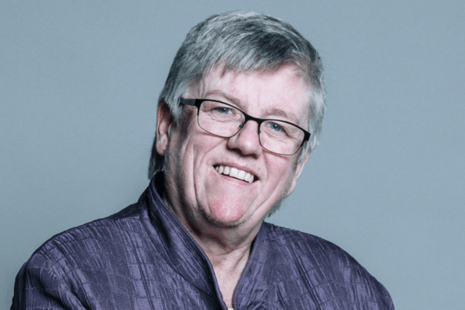
Baroness Ros Altmann

The first which was successful was put forward by Baroness Ros Altmann, a former Tory pensions minister, in a series of amendments. She had the support of Labour’s Baroness Sherlock, a former special adviser to Gordon Brown and an ordained priest at Durham Cathedral; Baroness Janke, a Liberal Democrat peer and former leader of Bristol council; and Baroness Boycott, a crossbench peer, feminist and former editor of the Independent newspaper.

It was one of these amendments that led to the defeat of the government in the Lords. This particular amendment had the support of former Labour Cabinet minister, Baron Hain, Liberal Democrat baroness Janke and crossbencher (and ex Conservative) Baroness Wheatcroft former editor of the Sunday Telegraph.

Basically the amendment challenged the government’s calculation of the rise in earnings at 8.1 or 8.3 per cent and wanted a new calculation stripping out the effect of the pandemic. Lady Altmann initially had put this at 3.8 per cent but yesterday suggested it could be as high as five per cent and then suggested she was had no firm figure. This particular approach had the support of Labour.

The official wording maintained the link with “earnings obtaining in Great Britain, as adjusted to take account of the exceptional impact of the COVID-19 pandemic on the level of earnings”.

She told peers: ” after seeing alcohol and fuel duty cut in the Budget and the bank surcharge allowance raised, and adding up the amount of Exchequer savings that those measures entail, half the cost of not honouring the triple lock will cover the costs of just those three measures. I appeal to noble Lords across the House: is this really the country that we believe that we should be living in? Is that the priority for public spending?”

The key point about this amendment is that it does not restore the full 8.1 per cent to pensioners and it leaves the government to decide if it wants to – the new earnings rate.

Baroness Stedman Scott, the DWP Lords minister, did not sound convinced. Referring to a blog on the Office for National Statistics site she said “Using a range of possible estimates based on a method that cannot be agreed on does not provide a sufficiently robust basis for making critical decisions about billions of pounds-worth of expenditure.”

Prem Sikka

The second more radical approach came from Prem Sikka, Lord Sikka. He was backed by Baroness Bennett, Natalie Bennett the former Green leader; Baron Davies of Brixton – Bryn Davies- a former Labour union leader; Baroness Blower, Labour and former general secretary of the National Union of Teachers and Lord Hendy, Labour, a barrister and labour law expert. Lord Sikka told them the government’s measure “is also contrary to the Government’s levelling-up agenda. Rather than levelling up, it impoverishes citizens and condemns millions of current and future retirees to a life of poverty and misery. There is no moral or economic rationale for this; indeed, none has been offered by any Minister so far.

“The Government’s own statistics, published on 3 September 2021, say that the average weekly pre-2016 state pension is £169.21 for males, £141.98 for females, and the overall mean is £155.08. The average weekly post-2016 pension is £166.34 for males, £160.11 for females, and the overall average is £164.23. As we can see from these figures, women are especially impoverished by the way that pensions are calculated and paid. They will be hit even harder by the abandonment or, as the Minister might say, the temporary suspension of the triple lock.”

….”Low pensions condemn our citizens to a life of misery. Some 1.3 million retirees are affected by malnutrition or undernutrition. Around 25,000 older people die each year due to cold weather, and we will no doubt hear the grim statistics for this year, possibly on 26 November when the next numbers are out. Despite the triple lock, the proportion of elderly people living in severe poverty in the UK is five times what it was in 1986, which is the largest increase among major western countries. Some 2.1 million pensioners live in poverty, and the poverty rate has actually increased since 2012-13.”

Baroness Fookes : Blocked official vote

Then extraordinarily Baroness Fookes, a Tory peer who was a deputy speaker, blocked a vote on Lord Sikka’s amendment leading Lord Sikka to say he was cheated. She argued that his opponents had made more noise than his supporters to justify the decision.

If this amendment had been passed it would have allowed pensioners to get the full uprating of 8.1 per cent but would have wrecked the bill. Labour did not support this and would have abstained. A spokesman for the Labour Whip’s office explained:”Prem’s amendment was not in line with the Lords’ constitutional position, in that it would wreck the core purpose of a bill that the Commons had already voted to support.

There was all party support however for a full impact study into pensioner poverty after peers from all sides had expressed concern about the plight of pensioners this winter and the DWP minister promised this when faced with possibility of yet another Lords revolt.. There was also a promise from the minister for a detailed explanation of the national insurance fund – which appears to have a £37 billion surplus which the government says cannot be used to pay for keeping the triple lock.

What is clear is that Rishi Sunak, the Chancellor, has been silent about this surplus in all the documents he produced to accompany the Budget. If it turns out that it has been used secretly to repay government debt I suspect there will be an all mighty row as 12 million pensioners will feel they have been cheated yet again by successive governments. Watch this space for more developments.

Read here who supported revising the triple lock and those who were against pensioners getting a penny more. Those in favour included 3 Tories, 99 Labour, 41 cross benchers,64 Liberal Democrats,13 non affiliated, including one Green Party and 2 Democratic Unionist Party.

Those against included 165 Tories, 11 crossbenchers and 2 non affiliated peers. Hereditary peers also voted against. You can see all their names on the link.

Please Donate to Westminster Confidential to allow me to continue my forensic investigations.

Please donate to Westminster Confidential

£10.00
Peers fight into the night for 12 million pensioners to get the full “triple lock” rise of over £14 a week

Baroness Stedman-Scott, DWP minister in the Lords who said bill would collapse if peers voted for the amendments

The government came under fire from all parties last night in a late sitting in the House of Lords for deciding to scrap the “triple lock” for pensioners- reducing next April’s rise from over £14 to £5.55 a week.

There also was a constitutional row when the Conservative Leader of the House of Lords, Baroness Evans, on advice from the clerks, wanted to rule out of order an amendment from Tory peer Baroness Stroud, on the £20 a week cut in Universal Credit. It was quite clear from her proposal – she worked with Iain Duncan Smith at the Centre for Social Justice – that she wanted MPs to to have a vote on the cut and was not happy with the policy.

The debate which ran on until midnight united rebellious Tories, Labour, Liberal Democrats, Greens and crossbenchers in opposition to the plans to break the earnings link.

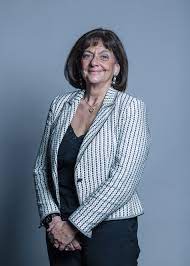
Baroness Altmann, a former Conservative pensions minister, proposed three amendments – all aimed at restoring in some way an earnings link – though offering the government a compromise by either linking to a lower earnings level or giving the highest rise to those pension credit – who are the poorest pensioners.

Lord Sikka – picture credit Twitter

By far the strongest criticism of the move came from the Labour peer, Prem Sikka, who wanted to scrap the clause altogether. He was backed by Baroness Bennett, the former Green Party leader and Lord Davies of Brixton, a former trade unionist and leader of the Inner London education authority.

He called for the full 8.3 per cent up rating to be paid:” In the 1980s, the Thatcher Administration broke the link between earnings and the state pension, and we never recovered from it. This is another example of where, once that link is broken, we will never really recover from it; the Minister so far has not said that in future the backlog will somehow be made up. Nothing has been said about that.”

“The current full state pension at the moment is £9,350 a year, and only four out of 10 retirees receive it. The average state pension is about £8,000 a year and, as has already been pointed out, is around 24% or 25% of the earnings. It is the lowest among industrialised nations, and by not increasing the state pension in line with average earnings we are going to condemn it to remain low.”

He said that state pensions were lowest in Europe – just 4.6 per cent od gross national product – compared to 10 per cent in Germany.

1.25 million women pensioners living in poverty

He asked: “Why is it that the Government are content for such low allocation to the state pension? What happened to the billions that the Government took from 3.8 million women by raising their state pension age from 60 to 66? What happened to the billions that the Government said would be saved by coming out of the European Union? Why have those resources not been used to lift our senior citizens out of poverty?”

He added: “Despite the triple lock, 2.1 million pensioners live in poverty, 1.25 million of whom are women. The poverty rate is higher now that it was in 2012-13. Many simply struggle to survive. Those retirees who try to top up their meagre state pension with part-time work will soon be hit by the Johnson tax: a 1.25% hike in national insurance. At the same time, what do we actually observe? For those rich people who make vast fortunes from capital gains and dividends, or speculation on second homes, commodities markets and securities markets, no national insurance contributions are payable on unearned income. That money could definitely be used to alleviate poverty, but the Government have not indicated any inclination to do that.”

“£8.50 a week is probably less than what many ministers pay for a glass of wine”

He said it would cost £4.7 billion to do so and could easily be raised by raising the national insurance levy on unearned income, such as shares or capital gains, which are exempt from the new levy.

“A triple lock based upon the existing formula could have given an increase of around 8% to 8.3%, adding up to about £14 a week in the full new state pension, instead of £5.55 a week. That is a difference of about £8.50 a week. Is that really a king’s ransom? It is probably less than what many Ministers pay for a glass of wine with their lunch.”

Baroness Bennett said she wanted a even more radical overhaul of the pensions system – saying no pensioner should live in povery and the con tributory system which is unfair to women should be abolished.

Baroness Stedman-Scott, junior minister at the Department for Work and Pensions, said if Lord Sikka’s proposal was passed the bill would collapse as it has only two clauses and asked for him to withdraw it. He did but promised to come back next Wednesday when the bill is debated again when he plans to raise the issue of the National Insurance Fund whose latest accounts show it has a £37 billion surplus. Curiously I learnt that Sir Keir Starmer, the Labour leader, did not want Labour peers highlighting the issue of the pensions ” triple lock” implying Labour was prepared to go along with the Tories over this issue but it seems pretty clear from the debate that this was ignored. Rather extraordinary that Labour don’t want to highlight the issue.

For those who want to see the debate go to https://parliamentlive.tv/Event/Index/3af431d5-923d-46d3-a9ec-3bf5a3ad7d2f and scroll down to 20:12:26 Legislation: Social Security (Uprating of Benefits) Bill – committee stage .It is a long debate lasting nearly four hours.

Please donate to my blog to continue through coverage and through forensic investigations

Donate to Westminster ConfidentiaL

£10.00

DWP dumps on benefit watchdog and ignores plea for more help for victims of domestic violence

The Department of Work and Pensions has rejected any changes to its new minimalist regulations to exempt victims of domestic violence -mainly women – from paying the ” bedroom tax ” and helping them to find out how they could qualify to keep more of their benefits.

Ministry turns down plea from social security watchdog

As I reported ten days ago the release of minutes from the little known Social Security Advisory Committee revealed in July the body chaired by Stephen Brien who worked for Ian Duncan Smith’s think tank had written to the ministry criticising the proposed regulations for being too narrow and the ministry for not running a prominent campaign to let victims know they will now be exempt.

The exemption applies to anybody who wants to stay in their own home and has thrown out an abusive partner and enrols in a sanctuary scheme – which provides extra locks, a fireproof letterbox and in extreme cases a reinforced door to a ” panic room” should the abusive partner return and break into the house.

The problem is that not all women know about this and the exemption only applies to council homes and flats. Also abuse from stalkers or strangers is not covered by the new regulations.

Mr Brien wrote: “Given the vulnerable situations of those affected, there is a compelling case for the Department to examine what options exist in terms of proactively identifying those potentially affected. This should be supplemented by a strong communications strategy that sets out clearly the criteria for this exemption, along with guidance on how to access it.”
“There is a risk that a number of claimants entitled to take advantage of this scheme, particularly those who have already benefitted from a sanctuary scheme security adaptation prior to these regulations coming into force, will be unaware of this change.”

Ministry rejects plea to change the regulation

But the DWP has told me not only will there be no changes but they had already implemented the regulations which came into force on October 1.

A DWP spokesperson said:

“The Department offers support to victims of domestic abuse, whether in the private rented sector or not. The benefit system acts as a safety net for people who find themselves in need of financial support with living and housing costs for a variety of reasons. A range of Universal Credit measures are designed to support victims of domestic abuse, including special provisions for temporary accommodation, same day advances, easements from work-related requirements and signposting to expert third-party services.”

Now for these regulations to become law they have to be scrutinised by Parliament. So I looked up what had happened.

It turns out the ministry laid the regulations before the House of Commons and the House of Lords on September 9 – a Thursday evening just before MPs and peers went off for the weekend. They were laid under what is known as a negative statutory instrument – which means that unless a peer or a MP objects they automatically can become law three weeks later.

Not one MP or peer spoke up about this

The regulations were laid alongside numerous other regulations including changes to Covid 19 pandemic regulations. Not one MP or peer objected or even spoke about it.

They would not have known about the criticism from the watchdog body because its minutes had not been published then. Nevertheless this shows up the ineffectiveness of MPs and peers – who have more time – in scrutinising what the executive is doing.

Given the high profile issue of violence against women after the kidnap and murder of Sarah Everard by a serving Met Police officer it is pretty deplorable that a ministry can get away with this.

Benefits watchdog keeps mum

I sent the ministry’s response to the watchdog body – which regards scrutinising regulations as its main priority – and it decided not to comment, preferring to keep silent about its advice being ignored .I haven’t had a reply from the House of Lords on why the new regulations were missed.

However I have discovered the ministry has issued new advice six days ago to its housing benefit officers. It is here and victims of domestic abuse should challenge officials about getting an exemption.

For those in England I would suggest contacting Shelter. The charity has a comprehensive guide for victims of domestic abuse here. It includes a list of other charities who can help.

So if the ministry, the social security watchdog and Parliament are so ineffectual, at least this blog can highlight some information so more people know about it.

Previous Blog

https://davidhencke.com/2021/10/03/exclusive-half-baked-and-half-hearted-dwps-help-for-women-facing-domestic-abuse-and-violence/

Please consider a donation to allow me to expand and develop this blog to hold more people and government to account

Donate to Westminster Confidential

£10.00

A Supreme Court verdict on Scottish human rights that could backfire on Dominic Raab and Boris Johnson

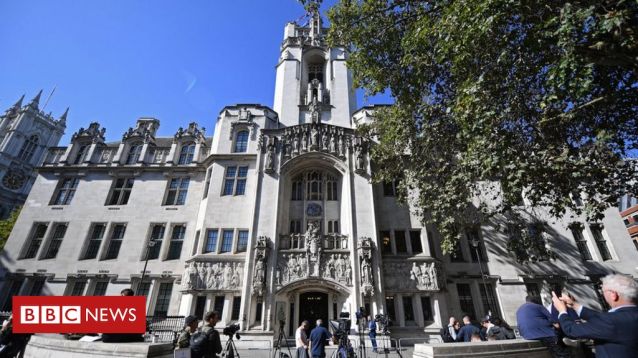
Last week the Supreme Court delivered a verdict against Scotland’s government that gave Boris Johnson a victory to stop both Scotland and Wales giving new rights to children, women, disabled people and protecting ethnic minorities from discrimination.

Supreme Court. Pic credit BBC News

The Tories were triumphant that Suella Braverman, QC, the Attorney General, employing the Treasury Devil. Sir James Eadie, to argue successfully that neither Scotland nor Wales could bring forward legislation to implement in full the UN convention on the Rights of the Child nor a European Charter on local self government. The Daily Mail said that it was ” a humiliation” for Nicola Sturgeon and could be used to stop any Scottish referendum. Tories in Scotland accused her of manufacturing a row with the UK by proposing to implement the charter in full.

The decision has implications for three other UN conventions – the Convention on Eliminating All forms of Discrimination against Women (Cedaw); a UN Convention outlawing racial discrimination and one giving full rights to disabled people effectively saying that even in areas of law already devolved to Scotland and Wales neither Parliament can legislate to implement these rights. The Scottish government was planning to introduce legislation to do this.

The immediate effect will be that Holyrood will have to remove clauses in two bills unanimously passed by the Scottish Parliament to take out measures that give extra rights to children or the Queen will refuse Royal Assent to the measures.

Westminster overrides Scotland

The decision basically gives untrammelled rights to the Westminster Parliament to override the Scottish Parliament if it is thought its new law conflicts with lesser rights for children in England.

The issue was argued on constitutional grounds – not on any issues of the rights of any of these groups- who will now be denied these rights purely by the Westminster government saying it is outside the competence of Scotland to legislate in this way.

The judgement was made by five elderly and middle aged male judges and argued equally by a middle aged QC – he is 59 -the same QC who successfully argued before the Court of Appeal that the Department of Work and Pensions had no obligation to bother to tell women born in the 1950s and 1960s that they weren’t going to get their pensions until the age of 66 instead of 60. One is tempted to say ” male, pale and stale” government rules supreme in Westminster- though I may be guilty of ageism.

All male judicial decision

The five judges who unanimously took the decision are

Lord Reed, President, aged 65, a Scottish judge, Baron Reed of Allermuir
Lord Hodge, Deputy President, aged 68, Patrick Stewart Hodge
Lord Lloyd-Jones, aged 69, David Lloyd Jones, President of the Welsh Law Council
Lord Sales, aged 59, Philip James Sales
Lord Stephens, aged 66, Lord Stephens of Creevyloughgare, a Northern Ireland judge.

The full judgement is here. The key phrase is that the changes are outside the competence of the Scottish Parliament under the 1997, Scotland Act which limited the powers of the Scottish Parliament to legislate for certain matters. The judges were careful to say that this was not about the rights of children under the UN Convention only the manner the legislation . This might provide a loophole for the Scottish government.

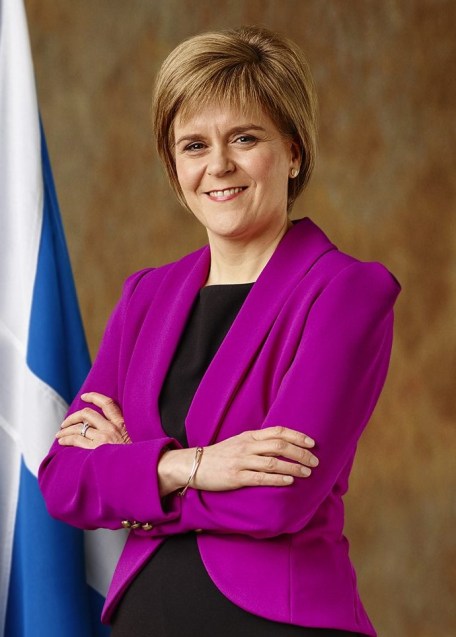
Nicola Sturgeon – official portrait

Nicola Sturgeon the SNP leader and first minister, said in a tweet: ” The current powers of the @ScotParl leaves us unable to full protect children’s rights, even in devolved areas. If our Parliament was independent, no such restriction would apply.

” Anyone thinking this is an abstract argument should reflect that also today, the UK government is taking £20pw from the pockets of the poorest families- making it harder for many parents to provide essential for their children”.

John Swinney, deputy first minister, said: “While we fully respect the court’s judgment and will abide by the ruling, we cannot help but be bitterly disappointed. It makes plain that we are constitutionally prohibited from enacting legislation that the Scottish Parliament unanimously decided was necessary to enshrine and fully protect the rights of our children.

“The judgment exposes the devolution settlement as even more limited than we all – indeed the Scottish Parliament itself -­ had understood.  It sets out new constraints on the ability of our elected Scottish Parliament to legislate to protect children’s rights in the way it determines.

“There is no doubt that the implications of this judgment are significant from a children’s rights perspective. This Bill will not now become law in the form which our Parliament agreed, but we remain committed to the incorporation of the UNCRC to the maximum extent possible as soon as practicable.  Whilst the judgment means that the Bill cannot receive Royal Assent in its current form, the majority of work in relation to implementation of the UNCRC can and is continuing.”

What we have here is a warning shot of a huge row which could also become a centrepiece in the debate over the Scottish independence referendum.

Official portrait of Dominic Raab, Lord High Chancellor

For at the same time Dominic Raab, the new justice secretary, wants to scrap the present UK human rights legislation which still allows appeals to the European Court of Human Rights.

It looks like – whatever the spin – is that he wants to take away human rights from women, the disabled, children and those facing racial discrimination- just at the point when Scotland and Wales want to extend them. We therefore have a perfect storm which could end with the break-up of the UK which is why I say this victory by Boris Johnson could backfire. It could end up being a Pyrrhic victory.

I am trying to extend the work of this website. Please donate if you can to continue my forensic investigations.

donate to westminster confidential

£10.00

Time for a new UN convention on the rights of older people

Today is the United Nations International Day of Older Persons. As the number of older people grows in developed countries they are becoming a much bigger force.

Yet as we see in the UK the government pays mere lip service to them – trying to present the general public with the idea that they are all well off and preferring to focus on the young.

Indeed the present Tory government thinks it can get away with targeting them – along with the poor- for the mainstay of their new post pandemic austerity polices.

In the last few years they have taken away free TV licences for the over 75s, abolished the ” triple lock ” for pension rises for one of the lowest state pensions in developed countries, continually raise the pension age and targeted women born in the 1950s and 1960s -taking away around £50,000 in pension payments by raising their pension age.

Many people aged 60 cannot now get free bus passes until they are 66 and ministers now have their plans to make them pay full prescription charges from the ages of 60 to 66 – knowing that far more of them are unhealthy and suffer chronic ailments than younger people. And they are going to reintroduce national insurance contributions for those over 66 who supplement their pension by working.

Older people facing redundancy

There are also problems for older people being targeted for redundancies -indeed the organisation Rest Less, (website here) which monitors job prospects for the over 50s, suggests that there were half a million people over the age of 50 on furlough according to the latest figures. They are reporting growing numbers of economically inactive people in their 50s and 60s. How are they going to get a full pension?

So it is rather good news that JustFair – a campaigning organisation – is calling for a new international convention on the rights of older people. You can read about them and their proposal here. Sufficient to say it highlights a lot of issues affecting older women – and it has the backing of CEDAWinLaw which held a tribunal examining women’s rights and the case for putting that UN convention on eliminating all forms of discrimination against women into UK law.

As it says: “Gender inequality in older age is the result of disadvantages accumulated over the life course and further exacerbated by ageism and age discrimination. As a result, many older women are denied their rights, a situation further aggravated by the COVID-19 pandemic with its disproportionate effect on both older persons and women. It is estimated that the impact of the pandemic increased the gender gap by a generation.  This means that women will continue to reach older age in a disadvantaged position unless structural changes are made“.

Internationally the UN is highlighting a huge digital divide between developed nations and developing countries over the internet with older people the worst affected.

Yet, one-half of the global population is off-line, with the starkest contrast between the most developed countries (87%) and the least developed countries (19%) (ITU Facts and Figures 2020).

Age UK Dacorum’s campaign to highlight the UN day

There are also lots of local events today highlighting the day. In my area in Hertfordshire Dacorum Age UK have a fund raising campaign called ” Slip into Slippers” celebrating the dignity of old age and the fact that many older people play a big role in the community.

Charlie Hussey, development officer for Age UK Dacorum said: “We are asking individuals businesses schools and clubs to get involved by Slipping into Slippers for some of the day, and encourage people to have some fun, make a small voluntary donation and take some photos / videos. All to raise funds and awareness of Age UK Dacorum and highlight the needs of older people and equally importantly the contributions they can still make to our community. “

I am also raising funds for my own website to develop my work holding the government and the powerful to account. Please donate if you can

westminster confidential

£10.00

HS2: The train going nowhere

Boris Johnson loves mad grandiose building projects ( remember the third London airport in the Thames Estuary) and more recently a tunnel/bridge under the Irish sea from Scotland to Northern Ireland.

Picturew of the design for the first HS2 trains

But what is emerging is that that even the most basic grandiose project -London’s Crossrail link and the high speed railway from London to Birmingham can’t be built on time to cost or even properly completed. A failure to integrate Crossrail with the rest of the railway system and continual cost rises for HS2 are the main reasons for delays.

MPs on the House of Commons Public Accounts Committee last week achieved one first – getting HS2 to provide some proper figures on the real costs. The entire HS2 project – if ever built from London to Scotland – will be £98 billion if not more. The first phase from London to Birmingham now has a budget of £44.6 billion – of which £11 billion has already been spent but we won’t see any results for the travelling public until 2029 at the earliest if not 2032. And probably in reality even later.

What is more disturbing is that service will initially run only from Birmingham to Old Oak Common in west London -not to London Euston where it can connect with other services.

Whitehall still quarrelling over the plans

Worse still internal Whitehall quarrelling means that they haven’t even fixed the most crucial arrangement – what will the Euston terminus look like.

“The redevelopment of Euston station is currently estimated to cost £2.6 billion. Despite HS2 Ltd telling us last year that the design of the station was ready for planning consent, the Department has spent the past 15 months looking for cost saving options and efficiency opportunities, including the potential for a smaller station.

” HS2 Ltd asserts that it is getting close to the point where the programme will literally run out of time if a decision is not made soon, and that Old Oak Common is being set as the London terminus when the railway first opens to decouple it from the risks at Euston.”

Gigantic building site at Euston. Pic credit: Global Railway Review

This is an extraordinary situation. It is made much worse because the area around Euston Station is now one gigantic building site after homes, shops and private businesses that border onto the existing station were demolished. And people living next to the site are being moved because of the noise and dust. And all for a new terminus whose configuration has still to be determined by the Department of Transport and which could be smaller than currently planned.

Further up the line there are disputes involving the land they are purchasing, environmental damage and pollution problems created by the development.

Volume of complaints rising

The MPs report: “We are already concerned about the volume of complaints on disruption from the programme which does not bode well for the future as more communities will be impacted as construction progresses. HS2 Ltd estimates it has handled 124,000 queries over the past three years and interacted with over 76,000 people along the route.

….”the number of complaints from the public about High Speed 2 has increased as main construction on Phase One has started. Complaints to the Independent Construction Commissioner HS2 rose to 86 in the first quarter of 2021 from 74 in the previous quarter. The majority of complaints are about the impact of construction on roads and traffic, vegetation clearance and about noise and vibration. Due to the scale of the programme and the time until the railway is complete, complaints are likely to increase.”

As part of its ” levelling up ” programme the government has promised to reskill the nation so people can get jobs as part of the regeneration of Britain post Brexit. Yet again the MPs point to further failures. The much trumpeted National College for High Speed Rail was a failure in attracting students and has had to be renamed the National College for Advanced Transport & Infrastructure and, most recently, merged with the University of Birmingham.

The MPs report: “The Department admits that the performance of the college has been disappointing and hopes that its latest merger, new leadership and new curriculum from September 2021 will be an opportunity to get the best out of the arrangement. Yet the Department’s involvement with the college has been limited as it falls under the Department for Education’s accountability remit.”

As for extending the railway to Scotland via Leeds and Sheffield that is in doubt and could be scaled back to Crewe. This has been partly confirmed by Grant Shapps, the transport secretary, who in an interview yesterday with the Financial Times has cast doubt on whether the line from Birmingham to Leeds along the eastern side of England will ever be built – hinting that other projects may have priority.

We want to make sure we get trains to Leeds in a way that actually benefits people on the network and not blindly follow some plan invented 15 to 20 years ago which no longer benefits people.” he said.

This completely contradicts what he said only in May when he promised the government would “complete HS2 and include HS2 on the eastern leg to Leeds”. All this suggests that costs must be mounting up with another U turn in prospect.

If this is levelling up – it is farcical

So what do we have here? An extremely expensive part built railway that may not even initially link Birmingham and central London beset with issues and aeons away from the dream of a high speed line linking Scotland with central London.

If this is to be an example of ” levelling up ” Britain it is just farcical. Meanwhile in the European Union we left the high speed train network goes from strength to strength with new lines and a sleeper train network planned that will reduce the need for air travel – all part financed by British train customers as most of the companies running our train services are owned by state rail companies based in the EU.

Our new high speed train system is going nowhere soon and causing nothing but pain and disruption.

Westminster Confidential

£10.00
Whitehall’s rip off ministry: The DWP dodges paying compensation to millions of pensioners – and the Parliamentary Ombudsman lets it off

Department for Work and Pensions or Department for Deviousness and Dishonesty?

You may remember I wrote a long article on a decision taken by the Government to no longer provide an index linked guaranteed minimum pension to millions of pensioners when they new pension came into force. The blog is here.

This decision never debated in Parliament meant the government has got away with not paying out anything from a £1000 to tens of thousands of pounds over the lifetime of their pension, depending on how long they were contracted out by their employer from the old SERPS scheme. The numbers could be as high as 11 million.

The Parliamentary Ombudsman, Robert Behrens, was asked to investigate and came to the conclusion that there had been maladministration and two people shared £1250 compensation. Unlike the row over the 50s and 60s born women who lost out by not being informed by the government over the rise in their pension age, no record exists, as far as I can find out, of the ministry repealing this provision in the 2014 Pensions Act.

Steve Webb: Ducking responsibility

And the man responsible for piloting that legislation, Liberal Democrat minister Sir Steve Webb, while publicly championing millions of women pensioners who have been underpaid by the ministry, is strangely silent about this issue which is he must be responsible.

What has happened since has taken morality and standards in Whitehall to new depths and exposed a level of deviousness and dishonesty among civil servants and cowardice in the Parliamentary Ombudsman’s Office that fittingly goes with a government headed by a serial liar.

In September 2019 the Ombudsman gave the ministry three months to sort out this issue. His proposals were quite clear. He asked the ministry to “review and report back on to us on the learning from this investigation, including action being taken to ensure that affected individuals receive appropriate communication from the DWP about their state pensions.

“ln particular, the DWP should ensure that their literature clearly and appropriately references that some individuals, who have large GMPs and reach State Pension Age in the early years of the new State Pension, may be negativity affected by the changes. The DWP should advise individuals to check their circumstances, and should provide instructions for how to do this;”

Sweet nothing happened

So what happened? Sweet nothing. The DWP ignored the deadline and then produced a factsheet which I know from correspondence the Ombudsman clearly felt did not fit the bill. But after one attempt to get this changed the Ombudsman dumped the issue and wimped out of getting the ministry to implement their recommendations.

Their press office told me: “

“We closed this case in November 2020 after working with the Department for Work and Pensions on compliance. At this point we referred the case to the Work and Pensions Select Committee, to oversee DWP’s ongoing work in this area. They will hold the Department to account on the actions it has agreed to take.

Actually the communication got lost and the committee knew nothing of this to the following April.

The DWP to cover its back claimed when challenged said:

“Working with the Ombudsman, we have now published information on gov.uk about this complex policy area and welcome anyone who wants to know how they have been affected by the policy change to contact us.

“Publishing this factsheet is the final step in the DWP meeting the requirements of the PHSO findings in relation to the way the GMP indexation policy change was communicated.”

It turns out that the Ombudsman agreed to this tardy response.

23 month delay

What finally happened was on August 12 in the middle of the Parliamentary recess, the department 23 months after being asked put out a publication notice amending its guidelines. The link is here.

I can’t imagine a more devious method about informing people and Parliament about this – in the middle of the August holiday. It is designed not to be seen.

Furthermore it does not comply with the recommendations which is why I say it is dishonest. There is no reference as you will see to the Ombudsman’s report, and the fact that people could be entitled to compensation. There is no mechanism for people to apply for the compensation and the notice was not even accompanied by a press release.

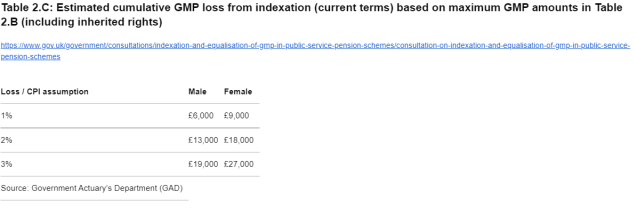
The losses are considerable for some people – about £27,000 for some women over the lifetime of their pension – but the information does not spell that out properly. Indeed all the DWP had to do was copy and paste as I have – a table from the Government’s Actuary Department ( at the bottom of this blog) which provided an ” oven ready ” guide to the losses.

Pathetic consultation using ignoramuses

A pathetic consultation process was held by the DWP – where they sought out the most ignorant people about pensions to comment- and only found seven out of 40 who agreed.. We only know this because the Commons Works and Pensions Committee published the details – the ministry itself has not published it.

There are probably millions of people who should at least get £500 in compensation but Therese Coffey, the secretary of state, is determined that nobody should know about it. It does not bode well for the 50s and 60s born women over their pensions compensation. She has already said the Labour Party should compensate the women not the taxpayer.

Time for a Women’s Rights Law and real radical change – CEDAW President’s report

Jocelynne Scutt, President of the CEDAW People’s Tribunal

A major blueprint for how the United Kingdom can transform its laws to end all forms of discrimination against women and properly implement the UN convention ratified by Margaret Thatcher in 1986 has been published by the CEDAW People’s Tribunal.

The 252 page report written by Jocelynne Scutt, with the backing of a researcher team,, proposes to end the piecemeal implementation of parts of the UN Convention Eliminating All Forms of Discrimination, both in national law and in different parts of the UK.

Its conclusion said: “The proposal now made by the CEDAW People’s Tribunal that the United Kingdom seize the opportunity now presented to it and introduce a Women’s Bill of Rights into the United Kingdom Parliament provides
a real opportunity to do this – create a climate where women’s rights are truly recognised as human rights, and human rights as women’s rights – with the United Kingdom taking the lead.”

it says it is time to replace fine words by politicians on women’s rights with deeds and includes comprehensive proposals backed up by research for almost every conceivable area of British life to improve the rights of women. Indeed in the space of one article it is impossible to encompass every area of this report – you will have to read and study it for yourself.

The shortcomings of the Equality Act

Some of the more dramatic findings reveal shortcomings in the 2010 Equality Act – which is probably the UK’s major contribution to women’s rights – both in sections that have never been implemented and the fact that its provisions don’t apply to Northern Ireland – which the present government insists should remain an integral part of the UK.

To back up that last point the report said:
” No devolved authority to have the power to undercut or reduce the provisions, extent or scope of the Women’s Bill of Rights and to address any potential conflict or proposal by any devolved authority to do so, the UK Act to include a provision prohibiting its terms from being excised from operation in the devolved jurisdictions. This provision to be based in the principle herein stated, namely that all women of the United Kingdom, wherever residing, are entitled to equal rights without being deprived of them by reason of residency in any devolved jurisdiction.”

But it does not rule out as Scotland and Wales introducing their own legislation both to improve any UK Act or if the government doesn’t introduce any legislation for Scotland and Wales to go ahead with their own law as they are proposing to do now.

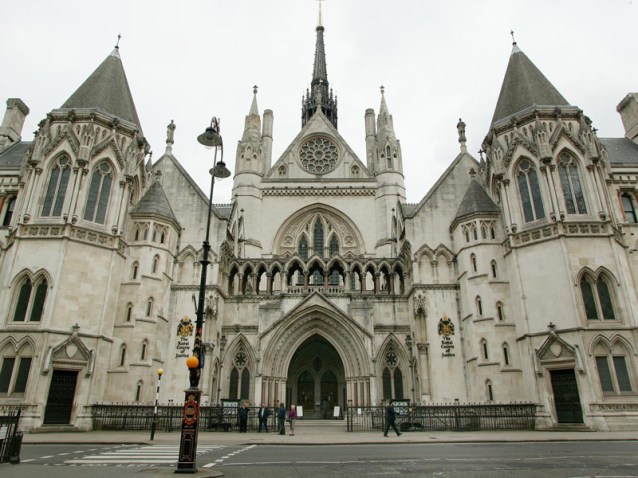
Royal Courts of Justice – time judges learnt about CEDAW

The report also insisted on widespread training for lawyers and public officials on what CEDAW means.

“That the Women’s Bill of Rights include a provision making it mandatory for members of the judiciary and magistracy at all levels to receive education and training on an initial and regular basis, including remaining up to date with CEDAW jurisprudence, and that this provision extend to all holders of public office, whether by appointment or election, in international, national and local bodies and authorities.”

This is a point I felt during the Court of Appeal hearing on the judicial review of women’s pensions that the judges did not seem to have a clue about CEDAW – and in my view this contributed to their decision to throw out the case.

It also makes it mandatory for every piece of legislation to have a gender impact assessment and for all government departments to have a gender impact assessment for every new policy they introduce. Since women are the majority in this country I would have thought that to be essential.

The report picked up that many women do not understand their rights because it is not presented in simple and clear language and the information is not available ( take the 50swomen case in informing women about the rise in the pension age for example).

The ” whole person ” approach to women’s rights and discrimination

There is also a failure to connect discrimination against women to other serious forms of discrimination. As the report said:

“The discrimination of women based on sex and gender is inextricably linked with other factors that affect women, such as race, ethnicity, religion or belief, health, status, age, class, caste and sexual orientation and gender identity. Discrimination on the basis of sex or gender may affect women belonging to such groups to a different degree or in different ways to men. States parties must legally recognize such intersecting forms of discrimination and their compounded negative impact on the women concerned and prohibit them.”

Where is particularly bad the report said the government should use “special measures” – specific legislation to address the problem – to end this inequality.

The report looked at major policy issues such as Brexit, climate change, the Covid 19 pandemic and the Windrush scandal and how they affected women.

It quoted evidence on how these separate issues impacted on each other. One passage read:

“The evidence further provided a snapshot view of the rise in hostility in the lead-up to, the confirmation of, and the continuing aftermath of Brexit. The Covid pandemic has exacerbated this, in that because Black and minoritised women (along with their male counterparts) have been in the forefront – both as doctors, nurses, healthcare workers and cleaning staff in hospitals, and suffering from being more susceptible to the virus – this has militated against their interests in the community, too – drawing racist attacks as if they are to blame because of that greater susceptibility”.

It tackled controversial issues such as migration, asylum seekers, women being detained in prison and made strong recommendations on how to deal with these issues. And it dealt with the lack of equal pay for women, and being forced by the partners into credit debts -coining the phrase ” sexually transmitted debt.”

” Sexually transmitted debt”

“This term, coined by lawyer Jenny Lawton and barrister Emma Swart recognises the position of women who, believing
their signature does not ‘count’ and under pressure that is difficult or impossible to counter, sign contracts – including mortgages and guarantees – at the behest of husband or partner, plunging them into debts they did not envisage, from which they do not profit, and which they did not wish to accumulate. Not infrequently, this occurs with the complicity, to a greater or lesser degree and even amounting to collusion, with banks or other financial providers.”

It also looked at faith marriages among the South Asian community which are not recognised by civil law and how they can lead to polygamous marriages, trafficking and women left with nothing in a divorce settlement.

This gives you an idea both of the breadth of issues covered by the tribunal and the need for widespread reform in many areas to give women full rights. And I haven’t touched on violence against women and domestic abuse.

This is truly a major document and a basis for major campaign to change the entire approach to women’s rights. Read it, digest it, and go forward and campaign for change.

UPDATED: CEDAW IN LAW goes to Downing Street to petition Boris Johnson to introduce a REAL Women’s Rights Bill

UPDATED: WITH FULL ROTHERS RADIO PROGRAMME ON CEDAW

Today a group of women from the CEDAW People’s Tribunal led by its president, former judge Dr Jocelynne Scutt went to Downing Street to petition the Prime Minister, Boris Johnson to introduce a comprehensive women’s rights bill.

This is the latest move in a campaign to persuade the government to implement the UN Convention to End All forms of Discrimination Against Women ratified by Margaret Thatcher as long ago as 1986.

It would pave the way for proper gender sensitive legislation and transform the rights of women still fighting for equal pay, equal treatment and better protection from, domestic violence, rape and abuse.

Above is a video now on You Tube of the event. I came along to report it for this blog

Dr Scutt was accompanied by four of the many legal assistants who helped the campaign. They are Katie Capstick, Pietra Asprou, Clara Guitau and Sara Vincezotti.

The event was organised by the steering committee involving Ann Fenner, Kris Gibson, Michaela Hawkins, Louise Matthews, Davina Lloyd and Joanne Welch.

One intriguing insight. The handing over of the petition was delayed a little as Boris Johnson, who was in residence, had to dash outside from No 10 to No 9 Downing Street. He was in the middle of the virtual G7 summit at the time with Afghanistan on his mind. No doubt once he got to see the petition it would remind him that there were also issues like women’s rights in the UK which are not going to go away either.

The next step shortly will be the publication of the report from the People’s Tribunal. There is also a radio interview with me, Joanna Welch and Davina Lloyd tonight who both organised the tribunal with the amazing help of human rights lawyers from Garden Court Chambers.

Ian Rothwell special programme on Salford City Radio

Special programme on BackTo60 and CEDAW; Interviews with Dr Davina Lloyd, chair of the CEDAW Tribunal Steering Committee; Joanne Welsh and myself talking about how the moves in Scotland and Wales are complementing the work of CEDAW. Press on the button below to hear the entire programme ( one hour)

Enjoy the programme and thanks to Ian Rothwell and Salford City Radio for allowing me to put it on my blog.